
M4A to MP3 Converter
Use AudioCut's M4A to MP3 converter to turn iPhone voice memos, Apple Music tracks, podcasts, and any M4A source into MP3 online — free, with no configured file size limit and an adjustable bitrate.

WHY AUDIOCUT
Why Choose AudioCut as Your M4A to MP3 Converter?
AudioCut provides a focused browser-based workflow for converting M4A audio to MP3. Preview the source, choose the section you need, select 128, 192, or 320 kbps, and export the result without opening desktop editing software.
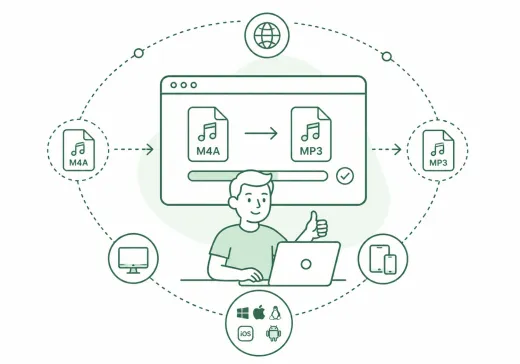
Simple Browser Workflow
Open the converter in any modern browser, choose your M4A file, and export it as MP3. There is no software to install and no account to create — the same workflow is available on Windows, Mac, Linux, iOS, and Android.
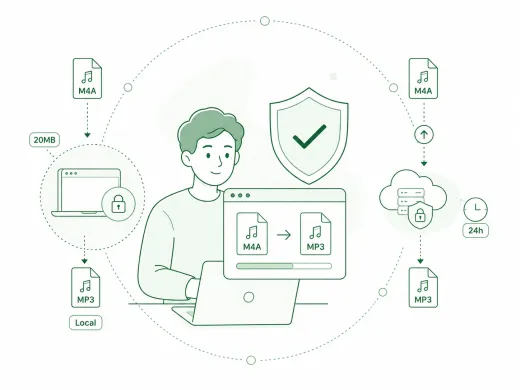
Privacy-First Processing
This conversion workflow processes your M4A source locally in the browser instead of uploading the audio for conversion. Practical file size and processing speed still depend on the browser, available device memory, source codec, and recording duration.
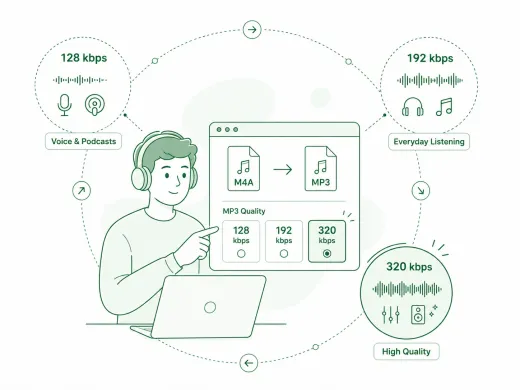
Adjustable MP3 Quality
Pick 128 kbps for voice memos and podcasts, 192 kbps for everyday listening, or 320 kbps when you want to retain more audio detail. The selected bitrate controls the balance between output quality and file size.
Preview Before Export
Play the source audio inside the converter and confirm the selected section before saving, so you do not export the wrong track or a clipped intro.
Free with Daily Credits
AudioCut is free to use with daily credits that cover most conversions. There is no subscription or surprise paywall, and the free allowance refreshes for more tasks.
Continue with AudioCut Tools
After using this M4A to MP3 converter, move on to trimming, compressing, merging, or making ringtones. The whole audio workflow stays in your browser.
HOW IT WORKS
How to Use the M4A to MP3 Converter Online
Convert M4A to MP3 by choosing a file, reviewing the audio, selecting an MP3 quality preset, and exporting the result in three clear steps.
Step 1
Choose Your M4A File
Choose an M4A file from your device to open it in the converter. iPhone voice memos, Apple audio files, podcasts, and other M4A recordings can all use the same workflow when their source codec is supported.
Step 2
Preview and Choose MP3 Quality
Review the audio and adjust the selected range if needed. Keep MP3 as the output format, then choose 128 kbps for voice memos, 192 kbps for everyday listening, or 320 kbps to retain the most detail.
Step 3
Export and Download
Save the selected audio as an MP3 file and download the result to your device. Processing time varies with file duration, source codec, bitrate, browser capabilities, and device performance.
MORE TOOLS
Continue with the next audio task
Extract, merge, or keep converting with the right tool.
Audio Trimmer
Trim MP3, WAV, AAC, M4A, FLAC, and other audio files with a visual waveform editor in your browser.
Audio Speed Changer
Speed up or slow down audio online, preview the timing, and export the new version from one editor.
MP4 to MP3
Convert MP4 video to MP3 audio in your browser. No upload, no file size limits, no sign-up — fast, 100% local processing.
Ringtone Maker
Create custom ringtone clips from songs and recordings with fast trimming, preview, and export in one editor.
Audio Compressor
Compress MP3, WAV, M4A, AAC, FLAC, OGG, and other audio files into lighter formats with quality presets.
Extract Audio
Pull clean audio from video files for lessons, interviews, recordings, and content repurposing.
USER FEEDBACK
How Creators and Editors Use This M4A to MP3 Converter
See how an online M4A to MP3 converter can fit podcast, lecture, music, transcription, and everyday audio-to-audio workflows.
4.9/5
A focused conversion workflow for creators, students, music listeners, and everyday audio tasks.
Browser-Based Conversion
Open an M4A file and prepare an MP3 from a modern browser.
Preview Before Export
Review the source and selected range before saving the result.
Adjustable Bitrate Control
Balance output detail and file size with three MP3 quality presets.
No Software Download
Complete the conversion without installing a desktop editor.

Sarah Connor
PodcasterI used the M4A to MP3 converter to prepare an audio version of a podcast episode. Previewing the track before export helped me confirm that the full episode was included.

David Miller
Music EnthusiastThe bitrate options make it easy to choose between a smaller MP3 and a higher-quality version when I turn my own M4A recordings into MP3.

Alice Smith
StudentI converted a lecture recording from M4A to MP3 so I could listen to it more easily. The preview and export controls were straightforward to use.

Mike Ross
Sound EngineerI use M4A to MP3 conversion for transcription references and quick previews. Being able to review the source before exporting is useful for everyday tasks.
Start Using the M4A to MP3 Converter
Choose an M4A file, preview the audio, select the section and bitrate you need, and export the result as an MP3.
Review the timeline, choose an MP3 quality preset, and save the audio you need.
M4A TO MP3 FAQ
Frequently Asked Questions
Answers to common questions about using the AudioCut M4A to MP3 converter online.
Before You Start
Learn about M4A and MP3 formats, bitrate choices, output quality, supported files, and mobile browser compatibility.
M4A is Apple's audio container format, also known as MPEG-4 Audio. It is commonly used for iPhone voice memos, iTunes or Apple Music audio, and podcast recordings. It typically contains AAC or ALAC audio and can deliver good quality at small file sizes, but it is not compatible with every device and media player.
MP3, or MPEG-1 Audio Layer 3, is a compressed audio format designed to reduce file size while maintaining practical sound quality. MP3 works with most phones, computers, media players, and audio applications. Output quality and file size depend partly on the bitrate selected during export.
Choose an M4A file, wait for the audio preview to load, confirm the section you want to export, keep MP3 as the output format, choose 128, 192, or 320 kbps, then save the result to your device.
MP3 uses lossy compression, so the exported file may not preserve every detail from the source track. A higher bitrate can retain more audio information, but it cannot restore detail that is missing from the source. For voice memos and podcasts, 128 kbps is often sufficient; for music or higher-quality recordings, consider 192 or 320 kbps.
Yes. The M4A to MP3 converter opens the source in a visual timeline where you can preview the audio and adjust the start and end points. This lets you export the full track or only the section you need.
The converter is designed for modern desktop and mobile browsers. Open the page, choose an M4A file stored on your device, preview the audio, and export MP3. Processing time and maximum practical file size depend on the browser, available device memory, source codec, and file duration.
Yes. AudioCut is free to use with a daily credit allowance that covers most M4A to MP3 conversions. There is no subscription or hidden paywall, and the free allowance refreshes for more tasks.